Carbon Reduction vs Offsetting: What's the Difference - and Which Should Come First?
Learn the difference between carbon reduction and carbon offsetting, and how to build a credible, science-aligned Net Zero strategy using both – in the right order.
Sustainability is full of buzzwords, technical language, and confusing trade-offs - and nowhere is that truer than in the debate between carbon reduction and carbon offsetting. Many businesses want to do the right thing but find themselves overwhelmed or misled by conflicting advice. Should you cut emissions internally? Buy offsets? Do both?
The truth is: doing both is great - but you should do them in the right order, and with a clear strategy.
Here’s a simple way to think about it:
- Carbon Reduction = Reducing the emissions your business is directly or indirectly responsible for.
- Carbon Offsetting = Paying for emissions to be reduced or removed elsewhere, to compensate for your own.
Let’s unpack what each of these involves - and how to use both in a smart, credible way to tackle your climate impact.
Carbon Reduction: Cutting Your Own Emissions
Carbon reduction means taking action to lower the amount of greenhouse gases your business produces. That includes direct emissions from things like company vehicles and buildings (known as Scope 1), as well as indirect emissions like purchased electricity (Scope 2), and finally emissions from your supply chain and products (Scope 3) - read more about these sources here.
In essence, carbon reduction is about owning your footprint and reducing it at the source.
Why Does Carbon Reduction Matter?
This is the most impactful, long-term way to drive change. Reducing your own emissions directly leads to fewer GHGs in the atmosphere. Decarbonising reduces our reliance on technologies like carbon capture that are still expensive, hard to scale, or not yet proven at the levels we need.
For businesses, reduction is often the smarter economic choice too. Efficiency improvements – think lower energy use or streamlined logistics – can reduce emissions and operating costs. Many upgrades come with an upfront cost, but the payback periods are shrinking. Even solar is starting to stack up for mid-sized businesses, thanks to falling prices and rising electricity costs.
More importantly, reduction is the foundation of any serious climate strategy. Offsets can play a role - but only after you’ve tackled your own house first.
How to Reduce Your Business Emissions (Step by Step)
1. Measure Your Carbon Footprint
You can’t reduce what you don’t understand. Start by calculating your current emissions using a recognised framework like the GHG Protocol. This gives you visibility into hotspots – areas of your business that produce the most carbon.
2. Identify and Implement Reduction Initiatives
Once you know where your emissions come from, you can begin making changes. This could involve:
- Switching to renewable electricity
- Upgrading to energy-efficient equipment
- Reducing business travel or switching to electric vehicles
- Engaging suppliers to reduce emissions in your value chain
- Cutting waste, especially food or packaging
You can learn more about common emissions hotspots, and how to reduce them, by reading our carbon literacy lesson here.
3. Track Progress Over Time
Measurement shouldn’t be a one-off. Regularly reviewing your emissions helps you track the impact of your initiatives, set new goals, and keep improving.
How Do You Know If You’re Being Ambitious Enough?
A good rule of thumb: follow the science.
The Science Based Targets Initiative (SBTi) was set up to do exactly that – provide a consistent, science-backed definition of Net Zero that businesses everywhere can follow.
Before the SBTi published its Net-Zero Standard in 2021, there was no widely used, science-based definition of what “Net Zero” meant. That led to confusion, inconsistency, and in some cases, greenwashing. The SBTi sets out a clear framework: how quickly emissions must be cut, by how much, and when carbon removals can be used.
The SBTi published version 2.0 of its Corporate Net-Zero Standard in June 2026. From Q1 2027 you can submit targets under either V1.3.1 or V2.0. From 31 January 2028, V2.0 is mandatory.
Under V2.0, you set near-term targets and can choose whether to add an overarching net-zero target. If you do, you set near-term and long-term targets covering Scopes 1, 2 and 3, with long-term targets set for 2050 at the latest. You reduce emissions to residual levels, then neutralise any residual emissions with carbon removals at your net-zero target date. Removals can only be used for neutralisation.
What you need to do also depends on your size. Category A covers any company with net turnover of €450m or more, or 1,000 or more employees. In high-income countries it also covers companies that meet lower thresholds on emissions, turnover, balance sheet or headcount. Category B is everyone else. Category A companies set separate Scope 1, 2 and 3 targets and publish a transition plan within 15 months of validation. Category B companies set Scope 1 and 2 targets.
Funding climate action beyond your own targets is recognised through the SBTi's voluntary Ongoing Emissions Responsibility programme, which has three levels: Engaged, Advanced and Leadership. The SBTi describes it as a complement to reductions, not a substitute.

By aligning with SBTi, you’re following a widely recognised benchmark that adds rigour and credibility to your strategy. No guesswork. No greenwash. Just a clear path rooted in climate science.
Once targets are set, track and report your progress transparently. It builds trust – and helps your team, customers, and stakeholders understand the impact you’re making.
What Is Carbon Offsetting – and How Does It Work?
Carbon offsetting means compensating for your emissions by funding projects that reduce or remove carbon elsewhere.
For example, you might support:
- Renewable energy projects in developing countries
- Reforestation or forest protection initiatives
- Methane capture from landfill
- Clean cookstoves that reduce wood-burning
The idea is to “balance out” your unavoidable emissions by making an equivalent positive impact elsewhere.
How Does It Work?
1. Measure Your Emissions
Just like with reduction, you should know your baseline before you decide on any figure to "offset". Your footprint often defines how many tonnes of CO₂ you may want to offset.
2. Offset Emissions
Once you know your emissions - say, 500 tonnes per year - you can purchase high-quality carbon credits that represent 500 tonnes of carbon reduced or removed elsewhere.
Do You Need to Offset Everything?
Technically, no. There’s no rule that says you must offset 100% of your emissions. Some businesses choose to offset more to become “carbon negative,” while others offset only a portion.
However, using your emissions as a benchmark helps ensure your contribution is proportionate to your impact. It also makes your claims (e.g., “carbon neutral”) easier to verify.
How Do You Offset Credibly?
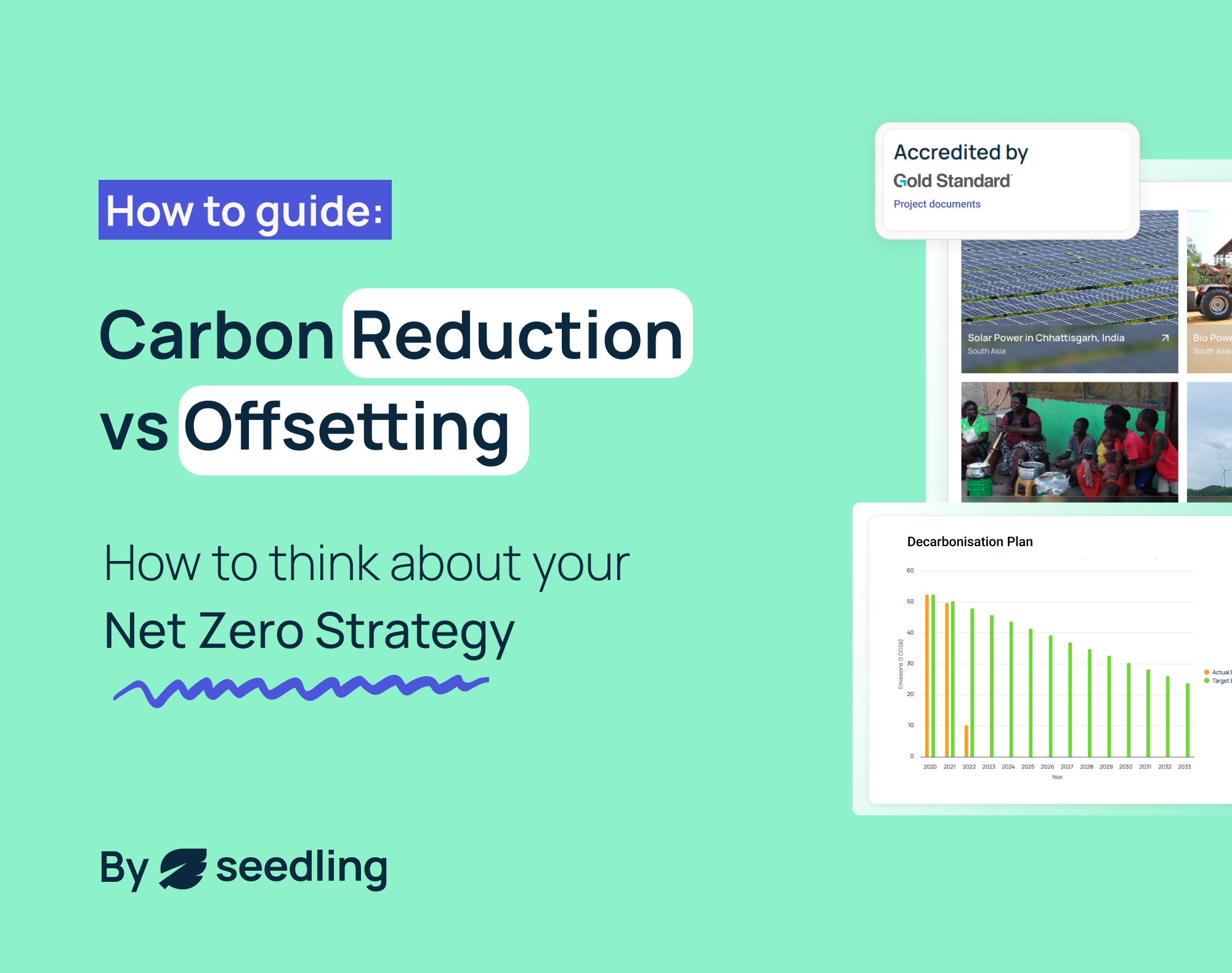
Not all offsets are created equal. To ensure your money is making a real difference, use accreditation schemes. Reputable standards like Gold Standard verify projects and ensure integrity.
What do they looking for when they verify projects? Here are the key principles for what makes a robust offsetting project:
- Additionality: The project wouldn’t have happened without your funding.
- Permanence: The carbon stays out of the atmosphere for the long term.
- No double counting: Only one organisation can claim each offset.
- Measurable and verified: Projects are audited to confirm real impact.
- Leakage: The project doesn't cause emissions to rise somewhere else.

These principles ensure that your investment delivers genuine, lasting carbon benefits.
As mentioned, offsets should complement your reduction efforts, not replace them. If you are working towards an SBTi target, credits used for the SBTi's Ongoing Emissions Responsibility programme cannot also count towards your target progress.
Carbon Reduction vs Offsetting: What’s Better?
If you’re choosing between reduction and offsetting, reduction always comes first.
Why? Because reducing emissions at the source has a direct and lasting impact. It also helps shift systems - like energy, transport, and materials - toward a low-carbon future.
Offsetting is still useful, especially for emissions you can’t avoid yet. But the main standards now set clear rules on how the two fit together. For example:
- ISO 14068 (Carbon Neutrality Standard) requires internal reductions as a precondition for credible offsetting. You can learn more about the standard by reading our dedicated blog here.
- The SBTi Net Zero Standard mandates deep reductions of at least 90% before offsetting residual emissions.
So it’s not a case of “offset or reduce” - the best approach is “reduce first, then offset responsibly.”
How We Help: Seedling’s Climate Action Platform
At Seedling, we help small and medium-sized businesses take practical, credible climate action without the jargon or overwhelm.
Our platform supports you to:
- Measure your carbon footprint with a simple, guided process
- Reduce emissions through tailored recommendations and tracking tools
- Offset what you can’t yet reduce with high-quality, verified projects
- Engage your team to build momentum and culture around sustainability
Whether you're just getting started or looking to level up your efforts, Seedling makes it easy to take action that’s both impactful and credible. You can book some time to chat with us here, or send us a message.
Start Managing
Your Carbon Footprint
Today
Benchmark your business’s climate action for free


Ready to get started?

Book a demo with one of our experts today, or get started right away for free.