What suppliers need to know about the NHS Evergreen Assessment and carbon reporting
If your business supplies to the NHS – or plans to – you’ll need to understand the NHS Evergreen Framework and carbon reporting rules.
The NHS Evergreen Assessment has been introduced to help simplify how suppliers demonstrate sustainability credentials with the NHS, with relevant data and reports all shared in one place.
In this guide, we’ll cover all you need to know about reporting carbon data through NHS Evergreen.
The NHS Net Zero strategy: what’s driving this?
The NHS aims to become the world’s first Net Zero health system. It has committed to:
- Net Zero for direct emissions by 2040
- Net Zero for wider supply chain by 2045
Since over 60% of the NHS carbon footprint lies in its supply chain, suppliers are a critical part of meeting these goals.
The route from these commitments to supplier requirements is the NHS Net Zero Supplier Roadmap, approved by the NHS England Public Board in September 2021, and updated in June 2026. It sets out what suppliers need to do between now and 2030. The table below shows the carbon milestones and where each Evergreen level fits in.
NHS Carbon Reporting: what’s currently required?
Let’s start with a quick bullet-summary of the current rules when it comes to carbon reporting to the NHS. We’ll then look at each requirement in more detail.
- Carbon Reduction Plans (CRPs) – PPN 006 (006)
- From April 2023: required for major contracts (£5m+ per year incl. VAT).
- Since April 2024: extended to all new procurements above threshold, applied proportionately (and at the procuring body's discretion). Contracts of £5m+ a year (inc. VAT) and all new frameworks and dynamic markets need a Carbon Reduction Plan aligned with PPN 006 (now called a 2024 Carbon Reduction Plan). Smaller contracts above the procurement threshold need a Net Zero Commitment.
- Evergreen assessment:
- From January 2024, suppliers bidding for NHS England Medicines tenders must submit an Evergreen assessment. Suppliers bidding for new NHS Supply Chain frameworks must submit one and reach Level 1.
- In April 2026, NHS updated the Evergreen maturity criteria to reflect the roadmap, including the April 2027 requirements (see below). NHS recommends completing the assessment annually, and each score is valid for 12 months.
- For all other suppliers, completion is recommended, and it is not a scored requirement in procurement.
NHS Carbon Reduction Plans (PPN 006)
At the moment, a report called a Carbon Reduction Plan (CRP) is required across most NHS procurement. A Carbon Reduction Plan (CRP) is a short document that shows your current carbon footprint and how you plan to reach Net Zero. Your CRP must follow a set format described under PPN 006 (formerly called PPN 06/21), which includes:
- Emissions for Scope 1, Scope 2, and selected Scope 3 categories
- A baseline year and most recent year’s footprint
- A clear Net Zero commitment (2050 or earlier)
- An action plan to reduce emissions
- Board-level or equivalent approval
- Publication on your website
- Annual updates (within 6 months of your financial year end)
For a plain English explanation of CRPs, and more detail on how to comply, we’ve written a practical guide to Carbon Reduction Plan compliance for suppliers. The team at Seedling have helped 100s of businesses – from 10 person fully remote teams to 400-strong global manufacturers – get Carbon Reduction Plan compliant and use the process to drive value for their business. So, if you need a hand, get in touch.
From April 2027, NHS Carbon Reduction Plans are changing (the next roadmap milestone) - and these changes will impact the steps suppliers need to take to prepare today. Read on to find out more.
What is NHS Evergreen Sustainable Supplier Assessment?
NHS Evergreen Sustainable Supplier Assessment is an online self-assessment tool that suppliers use to share sustainability information with the health service. It generates a ‘maturity level’ score based on how well the supplier aligns with NHS environmental priorities - particularly carbon reporting.
This score provides a baseline and helps both parties track progress over time. Suppliers can see what’s needed to move up to the next level and improve. Outside NHS Supply Chain frameworks and NHS England Medicines tenders, Evergreen is not currently a scored requirement in procurement.
Completing the assessment is optional for many suppliers today. The 2030 milestone in the roadmap is about published progress reports and continued emissions reporting. Evergreen is not named in it, but it gives you a route to show your Net Zero progress to NHS buyers.
Side note: while this guide focuses on carbon reporting, the NHS Evergreen Assessment also covers wider sustainability topics – including social value, modern slavery, and broader ESG performance.
What questions are asked in the NHS Evergreen Assessment?
The NHS Evergreen assessment consists of ~170 base questions, expandable to ~220 if you have a global parent with different targets to the reporting entity (the targets section gets repeated for the global entity).
Roughly 60% of questions are carbon-focused (targets, emissions, verification, reduction programme, product footprinting, renewables, fleet, shipping).
What’s the difference between NHS Evergreen and Carbon Reduction Plans (PPN 006)?
NHS Evergreen and the Carbon Reduction Plans (CRP) are different but complementary tools.
- A CRP is a standalone document required to bid for many NHS contracts. It focuses on emissions measurement and Net Zero targets, with a UK boundary and partial Scope 3 reporting as the minimum today, and global emissions reporting required from April 2027 for larger standalone contracts, frameworks, and dynamic markets.
- Evergreen builds on this by offering a broader view of a supplier’s sustainability maturity - including global emissions, year-on-year reductions, product-level footprints, and more.
Here’s a quick breakdown of how Carbon Reduction Plans and NHS Evergreen differ and overlap.
Evergreen builds on the CRP. A compliant Carbon Reduction Plan is required to reach even the first maturity level in the Evergreen assessment. From April 2027, a 2027 NHS CRP and Evergreen Level 2 ask for the same carbon scope: a global boundary and all relevant Scope 3.
How does NHS Evergreen scoring work?
The Evergreen Assessment evaluates suppliers against a set of sustainability criteria and assigns a maturity level from 1 to 4. These levels indicate the extent to which a supplier is aligning with NHS expectations around carbon reporting and sustainability:
- Level 1: Requires a published Carbon Reduction Plan aligned to PPN requirements, with a UK boundary, Scope 1 and 2, a subset of Scope 3 and a 2050 net zero target.
- Level 2: Moves to a global boundary and all relevant Scope 3, with a 2050 net zero target. This lines up with the April 2027 roadmap requirements.
- Level 3: Needs a 2045 net zero target, independently validated, with emissions verified for the reporting entity. Modern slavery requirements are added at this level.
- Level 4: Needs validated 2045 targets for both the reporting entity and any global parent company, transparency reporting through CDP, EcoVadis or B Corp, and modern slavery supply chain mapping or risk mitigation.
The requirements are summarised here in the Evergreen Sustainable Supplier Assessment Maturity Criteria Matrix:
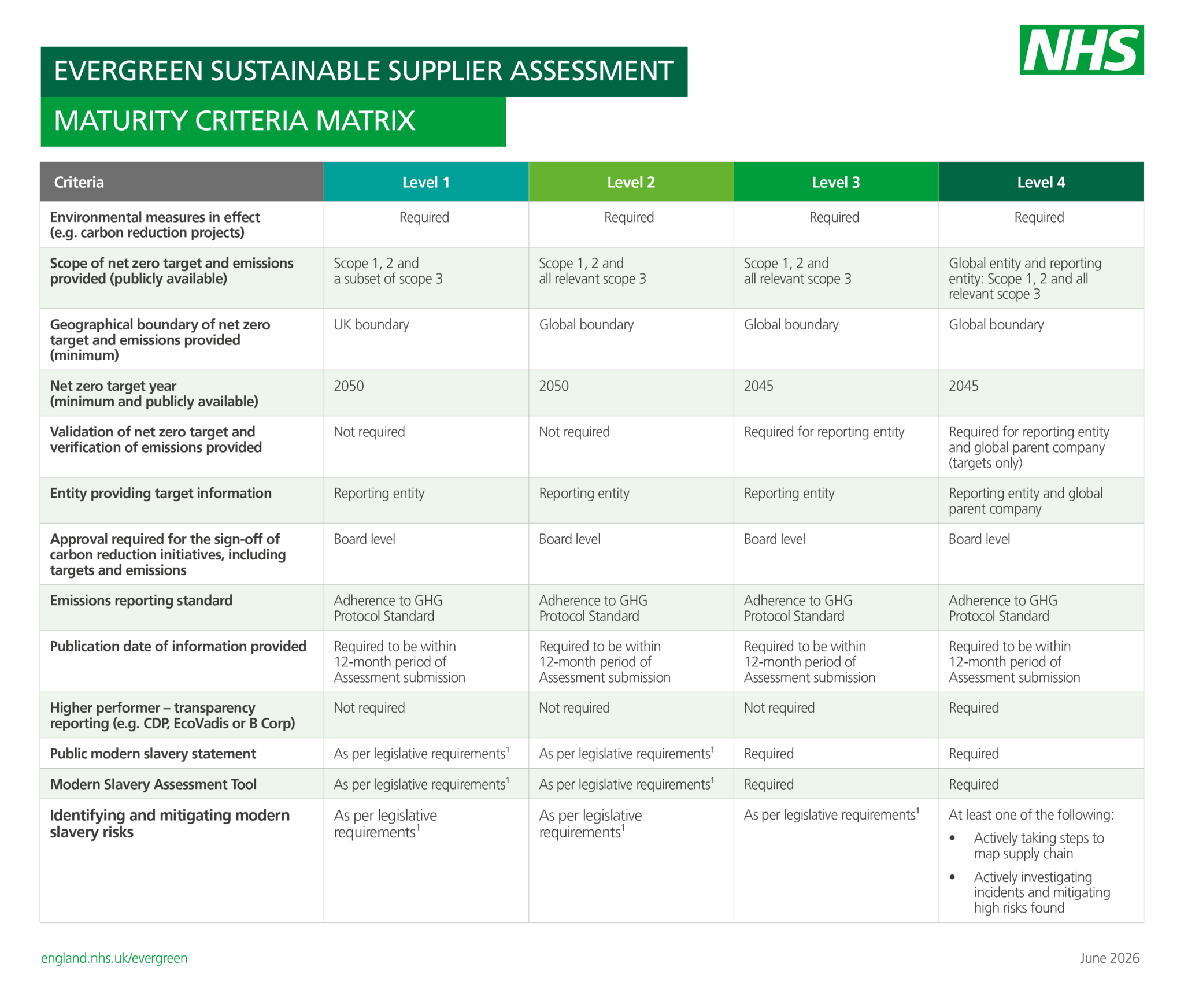
Suppliers are not expected to reach Level 4 immediately. The assessment is designed to encourage progression and readiness for future NHS requirements.
Who is required to complete NHS Evergreen assessment?
Some suppliers (those bidding for NHS England Medicines tenders or new NHS Supply Chain frameworks) are already required to complete Evergreen assessments. NHS Supply Chain bidders also need to reach Level 1. All other suppliers are 'recommended' to complete the assessment, though it's unclear whether this requirement will become mandatory.
Where to complete your Evergreen assessment
To complete the NHS Evergreen Sustainable Supplier Assessment:
- Register or log in to Atamis, the NHS commercial platform
- Go to the “Supplier Assessments” tile
- Complete the online questionnaire and submit your evidence
Carbon reporting for the NHS: what’s changing from 1 April 2027?
On 9 June 2026, the NHS published an update to its Net Zero Supplier Roadmap introducing new rules from 1 April 2027, and further requirements beyond. We've written a detailed breakdown of the new NHS carbon reporting rules, which you can read here. These changes eventually aim to go beyond commitments and require suppliers to demonstrate real reductions – as part of a wider push to meet the NHS Net Zero strategy, though what this means in practice is to be confirmed.
Coming soon:
- April 2027: CRPs must cover global Scope 1, 2, and all relevant Scope 3 emissions. This applies to procurements of £5m a year and above and to all new frameworks started from 1 April 2027. Smaller contracts stay on the 2024 CRP. Read the detail here.
- April 2028: New requirements for product-level carbon footprinting. NHS will set the scope and methodology with suppliers and regulators.
- By 2030: Suppliers will need to demonstrate progress to remain eligible for NHS contracts, through published progress reports and continued emissions reporting..
The Evergreen assessment will likely be a key part of showing progress. It's important to say that implementation plans are still evolving. We'll help you stay up to date!
Do I need to measure Scope 3 Emissions as an NHS supplier?
Today, only a partial Scope 3 footprint is strictly needed, including the below categories:
- Upstream transportation and distribution
- Waste
- Business travel
- Employee commuting
- Downstream transportation and distribution
However, the absence of full Scope 3 coverage will mean you're limited to Level 1 in the Evergreen assessment (check out the NHS Maturity Criteria Matrix above).
For in-scope procurements from From April 1 2027, all relevant Scope 3 emissions will be required, with an explanation for any category you class as not relevant. Since these tenders are likely to rely on plans produced in 2026, the transition to full-scope reporting needs to happen sooner than the April 2027 deadline. NHS accepts spend-based estimates for Scope 3. For FY 2027/28 tenders it will also accept gaps in first-year Scope 3 data, if you explain them and set out a plan to report the missing emissions from the following year. Starting early still means fewer gaps to explain.
How Seedling helps
We make carbon reporting manageable, accurate, and NHS-compliant:
- Measure full-scope emissions: Build an accurate, GHG Protocol-aligned footprint, including full Scope 3 emissions.
- Generate CRPs automatically: Fully compliant with PPN 006 (06/21) and NHS expectations. Signed and ready to publish.
- Track year-on-year progress: Our platform makes it easy to update footprints, compare results, and show real reductions, which feeds the progress reporting NHS will expect from 2030.
- Prepare for product-level footprints: Our product carbon footprint (PCF) tool lets you start product-level footprints now, ahead of NHS setting its 2028 requirements.
- Export bid-ready outputs: Whether for Evergreen, public tenders, or internal reporting – your reports are just a click away.
Supplying the NHS?
Start measuring, reporting and reducing now - with support at every step. Check out our work, or book a call with one of our experts. We'd love to help.
Further reading
Start Managing
Your Carbon Footprint
Today
Benchmark your business’s climate action for free


Ready to get started?

Book a demo with one of our experts today, or get started right away for free.