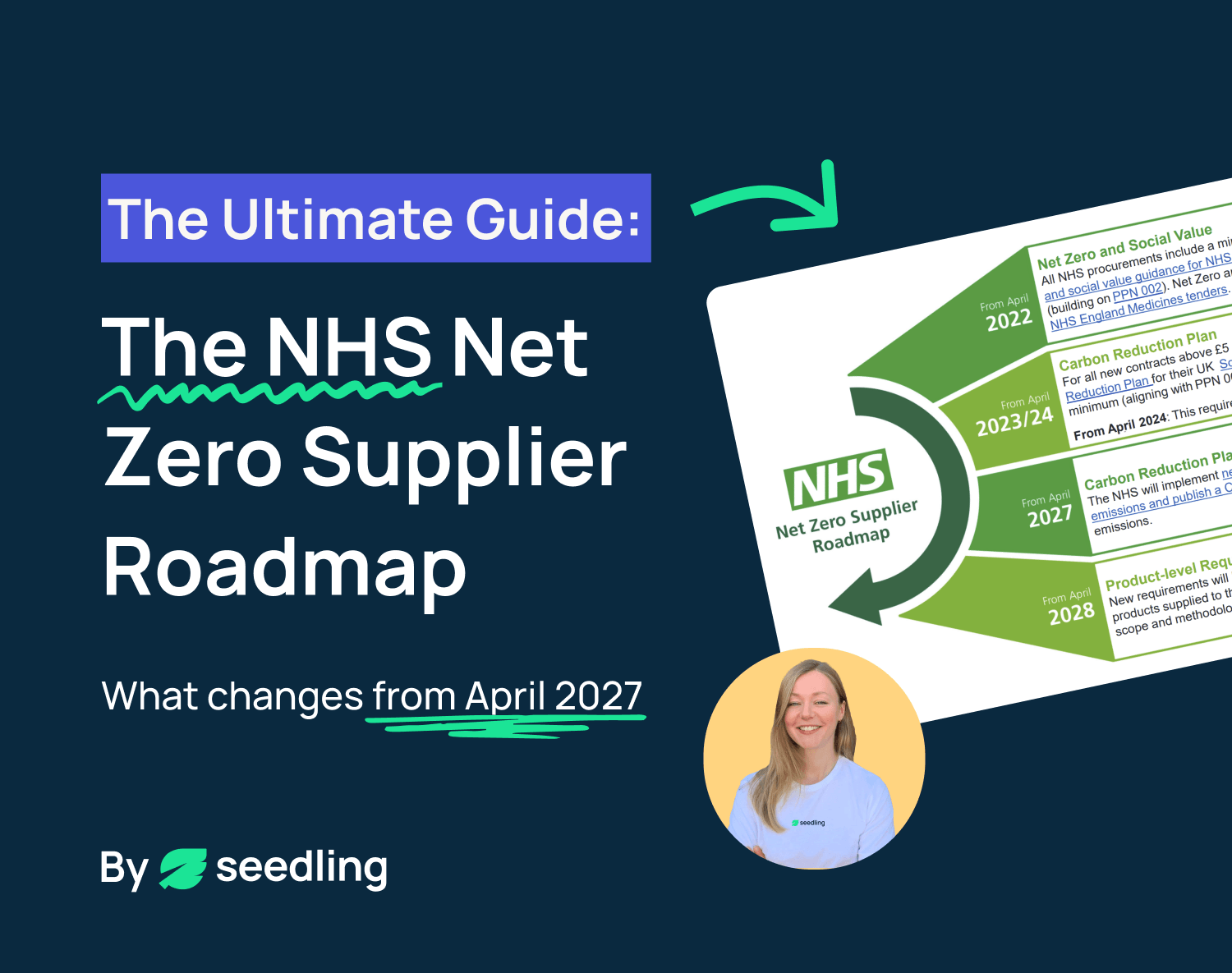
On 9 June 2026, NHS England published an update to its roadmap for engaging suppliers on Net Zero. The new guidance sets out the Carbon Reduction Plan (CRP) requirements that apply to its procurement from 1 April 2027.
What is the NHS Net Zero Supplier Roadmap?
The NHS aims to become the world's first Net Zero health system. It has committed to:
- Net Zero for direct emissions by 2040
- Net Zero for the wider supply chain by 2045
With around 60% of the NHS's carbon footprint sitting in its supply chain, suppliers are central to whether these targets are met. The NHS Net Zero Supplier Roadmap sets out the steps suppliers need to take to align with the NHS target. The ultimate aim is for suppliers to take practical steps to reduce emissions, and to demonstrate that progress with credible emissions data.
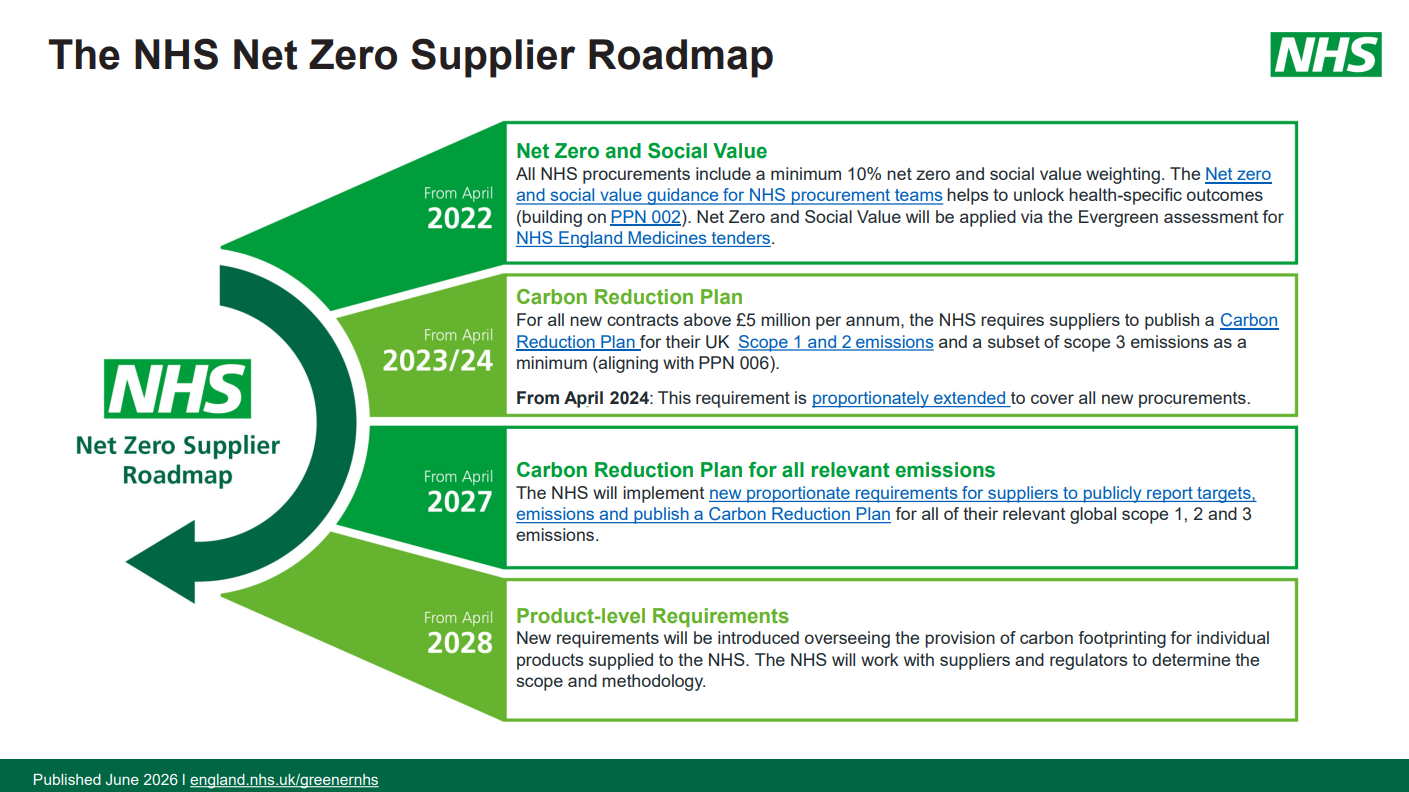
In this latest update, the NHS has built on and expanded what it expects from suppliers in terms of target setting and data reporting.
2024 vs 2027 NHS Carbon Reduction Plan requirements
The new NHS Carbon Reduction Plan requirements introduce a two-tier system of reporting. There are now two types of plan. The table below recreates the NHS's own summary comparison (Annex 2 of the guidance) and is worth reading carefully, because it separates three different things: what the 2024 tier asks for, what the 2027 tier makes mandatory, and what the NHS recommends as best practice on top. The recommended column is where suppliers aiming to stay ahead, rather than just compliant, should set their sights.
The headline change in the 2027 tier is the reporting boundary, expanding from UK operations and partial Scope 3 to global operations and all relevant Scope 3. On top of the hard requirements, the NHS recommends, but does not yet mandate, a 2045 Net Zero target, independent third-party target validation, and disclosure of how much of your target relies on offsetting. The detail is set out in Annex 1 of the updated NHS Carbon Reduction Plan guidance, with a side-by-side comparison in Annex 2.
The April 2024 CRP should follow the guidance set out in PPN 006.
What does "all relevant Scope 3" mean?
This is the biggest practical jump. Under the 2024 tier you report Scope 1, Scope 2 and a defined subset of five Scope 3 categories. Under the 2027 tier the subset is gone. In the guidance's own words:
"Suppliers must report emissions for all Scope 3 categories deemed relevant in adherence with the Greenhouse Gas Protocol Corporate Value Chain (Scope 3) Standard. For scope 3 categories deemed not relevant, an explanation, aligned to the standard, must be provided."
NHS England, 2027 NHS CRP requirements, Annex 1
In other words, you assess all 15 Scope 3 categories, report the ones that are relevant to your business, and justify any you leave out against the standard. The NHS accepts estimation methods, such as spend-based calculations, and recognises that supply-chain data is rarely complete, so it expects suppliers to take initial steps rather than have everything perfect from day one.
What does a "global" boundary mean?
The 2024 tier lets you draw the line around your UK operations. The 2027 tier requires a global boundary for both your Net Zero commitment and your emissions reporting, applied to whichever entity is doing the reporting. The guidance gives two worked examples:
Supplier to the NHS example: XYZ Medical Supplies Ltd. A UK-registered company bidding directly for NHS contracts, and a UK subsidiary of a wider global group. It reports emissions for its UK organisational boundary, which includes all related global emissions (for example, overseas product purchasing or freight linked to UK activity), in line with the GHG Protocol. It is therefore not limited to UK territorial emissions.
Global parent entity example: ABC Healthcare Global. The multinational parent of ABC Healthcare UK Ltd (the supplier engaging with the NHS). It reports on behalf of the UK entity, applying a global boundary covering all operations and emissions worldwide, including those of the supplier engaging with the NHS.
The point both examples make is the same: "global" is about the GHG Protocol organisational and operational boundary, not about UK-only territorial emissions. You choose the reporting entity, but the global boundary applies either way.
When does each NHS Carbon Reduction Plan tier apply?
Which plan applies is decided by the in-scope organisation, meaning any NHS body that commissions or procures the goods, services or works, including where it has appointed a third party to act on its behalf. Their choice depends on the procurement route.
Standalone contracts are a single public contract awarded on its own, by competition or direct award. These fall into the 2027 tier only if the contract is worth £5 million a year or more (including VAT). Below that, and above the relevant procurement threshold, the contract sits in the lighter 2024 tier.
Frameworks are an agreement that sets the terms for the contracts later awarded off it, known as call-offs. Any new framework has to apply the 2027 tier irrespective of the size of the individual contracts running through it.
Dynamic markets, under the Procurement Act 2023, are essentially an open, ongoing list of pre-approved suppliers. Suppliers apply to join the list (the "conditions of membership"), and buyers then run individual contract competitions among the members. Three rules follow:
- Any new NHS dynamic market has to require the tougher 2027 standard as a condition of joining the list, no matter how big or small the contracts on it are.
- Where a market's joining conditions only ask for the 2024 standard, whoever runs it should actively help member suppliers build up to a full 2027 CRP while they are on the list, rather than leaving them to it.
- The 2027 CRP can only be a requirement to join the market, not a requirement to win individual contracts run through it. This spares suppliers, especially SMEs, from submitting the same carbon information over and over to different NHS bodies.
What does "proportionate and relevant" mean?
Across all of these routes there is a release valve. The owner of a framework or dynamic market can decide the full 2027 standard is not proportionate to that market and apply the lighter 2024 standard instead. This is the lever for markets full of small and medium-sized enterprises (SMEs) that cannot realistically meet the 2027 bar yet. Before doing this, the buyer is expected to engage the market early and to document their reasons.
They can also drop the CRP requirement entirely. In a narrow set of exceptional circumstances, the NHS may ask for no CRP at all. The guidance lists three: where the market is so distorted or narrowed that delivery of services such as patient care, or value for money, is at serious risk; where a light-touch route is set up specifically to help SMEs or voluntary, community and social enterprises (VCSEs) access contracts and the CRP would be a barrier to entry, evidenced through market engagement; and where there is a civil emergency.
What the 2027 NHS rules mean for suppliers
If you sell to the NHS through frameworks or dynamic markets, plan for the 2027 standard as your default. The £5 million threshold will not protect you on those routes. Only on standalone contracts does value decide the tier.
In practice that means a global emissions boundary and all relevant Scope 3 categories, built on the GHG Protocol. If your reporting currently stops at the UK or covers only a handful of Scope 3 categories, that is the gap to close, and 1 April 2027 is the date to work back from.
How Seedling can help
Seedling is a carbon management platform that pairs intuitive software with one-to-one expert support, helping businesses measure a full-scope carbon footprint, reduce emissions, and report with confidence to the NHS. Trusted by 500+ businesses and a certified B Corp, Seedling is the practical solution for teams that need to get carbon reporting right without the cost and complexity of a traditional consultancy. From Carbon Reduction Plan compliance to the NHS Evergreen Assessment, we'll help you keep up to date with what's required of you as an NHS supplier. We'd love to hear from you, so get in touch.
Don't just take our word for it- hear from David Puttergill of Skin Analytics about building their first NHS Carbon Reduction Plan with Seedling.
FAQs
What about procurement commenced prior to 1 April 2027? Suppliers should continue to apply the requirements set out in the previous CRP and Net Zero commitment (NZC) requirements for the procurement of NHS goods, services and works.
How does the new NHS Net Zero roadmap relate to Carbon Reduction Plan compliance? This guidance builds on, and is intended to be used alongside, central government's guidance on PPN 006: Taking account of Carbon Reduction Plans in the procurement of major government contracts. Meeting the 2027 NHS CRP also satisfies PPN 006, because the 2027 tier goes further on emissions accounting.
Who is in scope? In-scope organisations are all NHS organisations that commission or procure such goods, services or works, including where they have appointed a third party to act on their behalf.
Who do the new rules apply to? The 2027 tier applies to procurements of high value (£5 million per annum and above, including VAT) and to all new frameworks operated by in-scope organisations, irrespective of the value of the contract, where relevant and proportionate to the framework.
How does this relate to Net Zero and social value? The requirement to provide a CRP is in addition to the minimum 10% weighting on Net Zero and social value that has applied to NHS procurements since April 2022.
Does my 2027 CRP need to be third-party validated? No. Independent third-party target validation and disclosure of offsetting reliance are recommended best practice, not hard requirements. The hard changes in the 2027 tier are the global boundary and all relevant Scope 3.
How recent does my CRP need to be? The reporting period should fall no more than 18 months before the date the tender notice is published. If it is older, you can still pass with an acceptable explanation.
What if I cannot gather all my Scope 3 data in time? In exceptional circumstances, suppliers with an acceptable reason can submit a CRP using the data they have, explain why other data is missing, and set out the steps they will take to improve it. This is assessed case by case by the contracting authority.
What period should my CRP cover, and how often must I update it? Your CRP should report on a single, consistent reporting period, tied to your own financial year. Under PPN 006 you should review and update the plan within six months of your financial year-end, and refresh it annually. At the point of bidding, the reporting period must be no more than 18 months before the tender notice is published, or you will need an acceptable explanation for why it is older. Keep to the six-month habit and you will always sit comfortably inside the 18-month window.
How does the NHS enforce carbon reduction plan requirements? The annual update obligation is written into contract and framework terms, not left to good intentions. For frameworks, the host organisation must include it in the framework's terms and conditions, and is responsible for the supplier due diligence that checks updates are actually received. For contracts arranged under the Provider Selection Regime, the requirement for annual updates goes into the contract terms and conditions. The duty sits at framework or contract level, not with individual call-offs.
Appendix and further reading
- NHS England, 2027 NHS Carbon Reduction Plan requirements for the procurement of NHS goods, services and works: https://www.england.nhs.uk/long-read/2027-nhs-carbon-reduction-plan-requirements-for-the-procurement-of-nhs-goods-services-and-works/
- NHS England, previous CRP and Net Zero commitment requirements (apply to procurements started before 1 April 2027): https://www.england.nhs.uk/long-read/carbon-reduction-plan-requirements-for-the-procurement-of-nhs-goods-services-and-works/
- NHS Net Zero Supplier Roadmap (overview, Greener NHS): https://www.england.nhs.uk/greenernhs/get-involved/suppliers/
- NHS Net Zero Supplier Roadmap, June 2026 (PDF): https://www.england.nhs.uk/greenernhs/wp-content/uploads/sites/51/2026/06/nhs-net-zero-supplier-roadmap-june-2026.pdf
- NHS England, Net Zero Supplier Roadmap April 2027 milestone: market sounding findings: https://www.england.nhs.uk/publication/net-zero-supplier-roadmap-april-2027-milestone-requirements/
- PPN 006: Taking account of Carbon Reduction Plans in the procurement of major government contracts: https://www.gov.uk/government/publications/ppn-006-taking-account-of-carbon-reduction-plans-in-the-procurement-of-major-government-contracts
- GHG Protocol Corporate Value Chain (Scope 3) Standard: https://ghgprotocol.org/corporate-value-chain-scope-3-standard
- NHS England Sustainable Supplier Accelerator (free webinars and support): https://www.england.nhs.uk/nhs-commercial/sustainability/
Contains public sector information licensed under the Open Government Licence v3.0.
Start Managing
Your Carbon Footprint
Today
Benchmark your business’s climate action for free


Ready to get started?

Book a demo with one of our experts today, or get started right away for free.
.svg)