The EU ECGT Directive Explained: What Businesses Need to Know Before September 2026

If your business sells or markets to EU consumers, and makes environmental claims - on your website, in marketing materials, or on product labels - the ECGT directive is something you need to understand before September 2026.
The ECGT (Empowering Consumers for the Green Transition Directive EU 2024/825), often loosely referred to as the EU greenwashing directive, is a piece of EU legislation that fundamentally changes the rules around environmental and sustainability claims. Adopted on the 28th February 2024 and published in the Official Journal of the European Union on the 6th March 2024, it entered into force on the 26th March 2024. EU member states were required to transpose it into national law by the 27th March 2026, with the rules applying in full from the 27th September 2026.
That deadline is now approaching fast, and the implications extend well beyond the EU's borders.
What is the ECGT directive?
The ECGT directive amends two existing pieces of EU consumer law: the Unfair Commercial Practices Directive and the Consumer Rights Directive. Together, these govern how businesses communicate with consumers about the environmental, social, and circular aspects of their products and services.
The core principle is straightforward: vague or unsubstantiated environmental claims are no longer permitted. If you cannot back up what you say about your environmental performance with clear, verifiable evidence, you cannot say it.
The directive forms part of the European Green Deal and the Circular Economy Action Plan - the EU's broader legislative push to reach climate neutrality by 2050.
What does the ECGT directive actually ban?
The directive adds to the existing list of commercial practices that are automatically considered unfair, without requiring a case-by-case assessment. The key prohibitions are:
- Generic environmental claims
- Overstating the scope of a claim
- Product-level carbon neutrality claims
- Unverified sustainability labels
1. Generic environmental claims
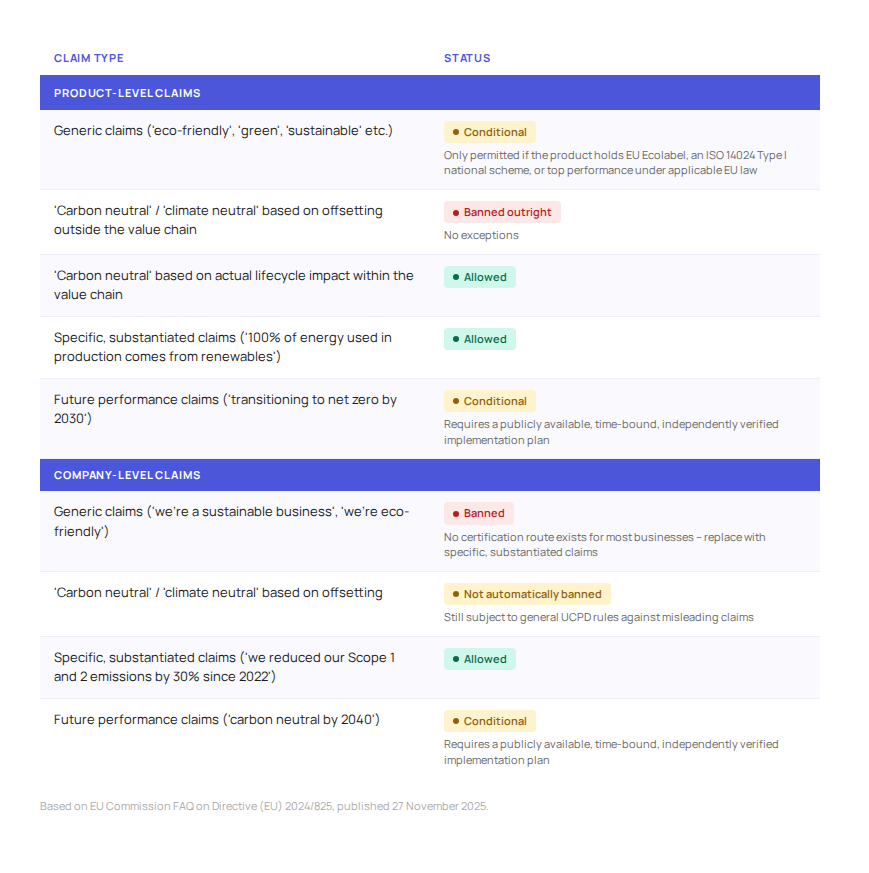
The directive prohibits what it calls 'generic environmental claims' '- defined as any written or spoken environmental claim where the specification of the claim is not provided in clear and prominent terms on the same medium. Terms such as 'environmentally friendly', 'green', 'carbon friendly', 'eco', 'sustainable', and 'biodegradable' are cited by the Commission as examples of generic claims that are prohibited unless recognised excellent environmental performance can be demonstrated.
It is worth noting that the prohibition is not limited to claims about products or services. The blacklist prohibition applies to any trader making a generic environmental claim - covering claims about products, product categories, brands, and businesses alike. The Commission's FAQ document states the banned practice as: "Making a generic environmental claim for which a trader is not able to demonstrate recognised excellent environmental performance relevant to the claim."
There are two routes to compliance.
The first is holding a recognised official certification relevant to the specific claim being made. The directive defines 'recognised excellent environmental performance' narrowly: compliance with the EU Ecolabel, a national or regional EN ISO 14024 Type I ecolabelling scheme (such as the Nordic Swan or Blue Angel), or top performance under other applicable Union law such as the Energy Labelling Regulation. These are product and service-level certifications - the European Commission's FAQ document on the ECGT Directive (November 2025) confirms that terms like 'green' and 'eco-friendly' can be used on products awarded these certifications. Importantly, because recognised official certifications are awarded to specific products or services rather than businesses as a whole, generic environmental claims cannot be made at company level - a business cannot describe itself as 'green' or 'sustainable' on this basis.
The second route - and the more practical one for most businesses - is to specify the claim precisely. The Commission's FAQ document is clear on this: "Whenever the specification of the environmental claim is provided in clear and prominent terms on the same medium, such as the same advertising spot, the product's packaging or online selling interface, the environmental claim is not considered to be a generic environmental claim." A direct example is given: "The claim 'climate-friendly packaging' (without further specifications) is considered a generic environmental claim. In contrast, a claim like '100% of energy used to produce this packaging comes from renewable sources' would be considered a specific environmental claim and does not fall under the prohibition on generic environmental claims."
In practice this means that vague environmental language - 'green', 'sustainable', 'eco-friendly' - is off limits unless backed by official certification. But specific, evidenced claims about what you have actually done remain permissible, as long as they are accurate and substantiated. The directive does not ban environmental communication, it bans environmental communication that cannot be backed up.
2. Overstating the scope of a claim
An environmental claim cannot imply broader sustainability than the evidence supports. A product cannot be marketed as ‘made with recycled material’ if that applies only to the packaging. A company cannot present itself as running on renewable energy if its facilities primarily rely on fossil fuels.
3. Product-level claims based on offsetting
This is the provision with the biggest practical implications for how businesses communicate their carbon performance. Phrases such as ‘climate neutral’, ‘carbon positive’, ‘CO2 neutral certified’, and ‘climate net zero’ are prohibited unless a product's actual lifecycle impact is genuinely climate neutral. These claims cannot be based on offsetting emissions outside the product's own value chain. Purchasing carbon credits to close the gap does not qualify - the product's emissions must be genuinely neutral across its lifecycle without offsetting outside the value chain. The test is whether your product's value chain, from raw materials through to end of life, stores or removes more carbon than it emits, through processes that are part of that value chain itself.
In practice, this means that a product marketed to EU consumers as carbon neutral on the basis of purchased carbon credits cannot carry that claim from September 2026. This specific blacklist ban applies to product-level claims only. A company making a corporate-level carbon neutral claim based on offsetting is not subject to the same automatic ban, though such claims remain subject to the general rules against vague or misleading marketing. The claim must be grounded in what has actually been measured and reduced.
4. Unverified sustainability labels
Sustainability labels, including any voluntary marks highlighting a product's or business’ environmental or social characteristics, can only be displayed if they are backed by a certification scheme that is transparent, open to all businesses, developed with expert input, and monitored by an independent third party that is legally separate from the scheme owner, and accredited to relevant international standards such as ISO 17065.
What this means for Seedling Certified Businesses:
From September 27th 2026, Seedling-Certified businesses that sell or market to consumers in the EU will need to have their certification checked by an independent third party. We're engaging our verification partners to ensure the required checks are in place - your account manager will get in touch if this applies to your business.
5. Presenting legal requirements as distinguishing features
Businesses cannot claim that their product is distinctive simply because it meets legal requirements that apply to all products in that category. For instance, advertising the absence of a substance that is already broadly prohibited, is not allowed.
Does the ECGT directive apply to UK businesses?
The short answer is: it depends on where you sell.
The UK is no longer an EU member state, so the ECGT does not automatically form part of UK law. However, the directive applies to any trader engaging in commercial practices towards EU consumers - regardless of where that business is headquartered.
If you sell or market to customers in EU member states, or use sustainability labels in EU consumer markets, the directive applies to you. This includes businesses shipping to EU consumers from a UK-based website.
Even UK businesses with no direct EU presence may face indirect implications. The UK's Digital Markets, Competition and Consumers Act 2024 and the CMA's Green Claims Code already set comparable expectations domestically, and enforcement of both is tightening. The direction of travel is consistent between the UK and EU.
What about the EU Green Claims Directive?
The ECGT is frequently discussed alongside the EU's proposed Green Claims Directive (GCD), which was designed to go further still - requiring pre-verified, science-based substantiation for all explicit environmental claims. In June 2025, the European Commission announced its intention to withdraw the GCD proposal, following pressure over the administrative burden it would place on smaller businesses.
Importantly, the withdrawal of the EU’s Green Claims Directive proposal does not affect the ECGT in any way. The ECGT is already law, will apply from September 2026, and is entirely unaffected by what happens to the GCD.
Why this matters for carbon accounting and reporting
The offset-based carbon neutral claim ban is the provision most directly relevant to businesses currently involved in carbon measurement and reporting.
Many companies describe themselves as ‘carbon neutral’ or on a path to ‘net zero’ on the basis that they have purchased verified carbon credits to offset their measured emissions. Under the ECGT, that basis is no longer sufficient for a product-level consumer-facing claim in EU markets. The claim must reflect what a business has genuinely reduced, and to demonstrate that, you first need accurate, substantiated carbon data.
This is where robust carbon accounting becomes a compliance issue, not just a reporting aspiration. Without a credible, full-scope carbon footprint, businesses have no reliable foundation from which to make or defend environmental claims. That matters to finance, operations, and compliance teams as much as to sustainability leads.
Businesses with verified carbon data and genuine reduction plans are well-placed under this regulation. The ECGT directive is designed precisely to distinguish them from those relying on vague language and unverified labels. Getting your carbon measurement right is not just about ticking a compliance box, it is about having something substantive and defensible to say.
What should businesses do before September 2026?
1. Audit your environmental claims. Review all marketing, website copy, packaging, and sales materials that reference your environmental performance. Identify anything vague, unsubstantiated, or based solely on offsetting.
2. Get your carbon data in order. If your claims are going to be tested, you need a defensible, accurate, full-scope carbon footprint - one that goes beyond high-level estimates to capture activity-level data across all three scopes of the GHG Protocol, including the Scope 3 emissions that often represent the largest share of a business's footprint.
3. Check your sustainability labels and certifications. If you display any third-party certification or sustainability mark, confirm that the scheme behind it meets the ECGT's requirements for transparency and independent third-party verification. For B Corps selling in EU markets, B Lab has confirmed it is updating its certification model to comply with the directive ahead of the September 2026 deadline.
The bottom line
The ECGT directive raises the bar for environmental claims across the EU, and whether it applies to your business directly or not, the underlying message is clear: the era of vague green marketing is ending. Regulators in both the UK and EU are moving in the same direction, and businesses that can back up what they say with accurate, verified data are the ones that will stay ahead of it.
That starts with knowing your numbers. A credible carbon footprint is the foundation for any environmental claim worth making. Without it, you are exposed, but with it, you have something substantive to build on.
Seedling helps growing businesses measure a full-scope carbon footprint, reduce emissions, and report with confidence - with expert 1:1 support built in at every stage. If you want to get your carbon data in order ahead of the ECGT deadline, get in touch with the team or explore how Seedling works.
Frequently asked questions
- What does ECGT stand for? ECGT stands for Empowering Consumers for the Green Transition. The full title of the legislation is Directive (EU) 2024/825 of the European Parliament and of the Council.
- When does the ECGT directive come into effect? The rules apply in full from 27 September 2026. EU member states had until 27 March 2026 to transpose the directive into national law.
- Does the ECGT directive apply to UK businesses? Not automatically, but if your business sells or markets to consumers in EU member states, the ECGT applies regardless of where you are based. UK-only businesses are not directly captured, but face comparable requirements under the CMA Green Claims Code and the Digital Markets, Competition and Consumers Act 2024.
- Can businesses still make carbon neutral claims? Under the ECGT, product-related claims such as ‘carbon neutral’ or ‘climate neutral’ are prohibited in EU consumer-facing communications unless based on a product's actual lifecycle impact - not on the offsetting of emissions outside that value chain.
- What is the Green Claims Directive, and is it different from the ECGT? The Green Claims Directive was a separate, more detailed proposal that would have required pre-verification of all explicit environmental claims. The European Commission announced its intention to withdraw the proposal in June 2025. The ECGT is unaffected and remains in force.
Start Managing
Your Carbon Footprint
Today
Benchmark your business’s climate action for free


Ready to get started?

Book a demo with one of our experts today, or get started right away for free.
.svg)