The best carbon management software does more than calculate emissions. It helps businesses set science-based targets, model reduction pathways, and produce compliance-ready outputs.
For companies up to 2,000 employees, Seedling combines powerful software with dedicated expert support. For large enterprises with in-house sustainability teams, Watershed and Persefoni lead the market.
Carbon management software is no longer a nice-to-have. Regulatory pressure, investor scrutiny, and supply chain requirements mean companies need accurate data, credible targets, and a clear reduction plan, not just a number on a spreadsheet.
This guide covers the platforms that go beyond measurement to genuine carbon management: target-setting, decarbonisation planning, and stakeholder-ready reporting. We have included the enterprise leaders alongside Seedling, so you can find the right fit for your organisation's size, resource, and ambition.
The 6 Best Carbon Management Software Platforms: Our Top Picks
1. Seedling: Best for Growing Businesses That Need Expert Guidance Alongside the Software
Why we picked it: Seedling is the only platform on this list that pairs carbon management software with a dedicated carbon expert included as standard. You get a full Scope 1, 2, and 3 footprint aligned with the GHG Protocol, a bespoke decarbonisation plan, and SBTi-aligned target-setting, without handing the whole process over to consultants.
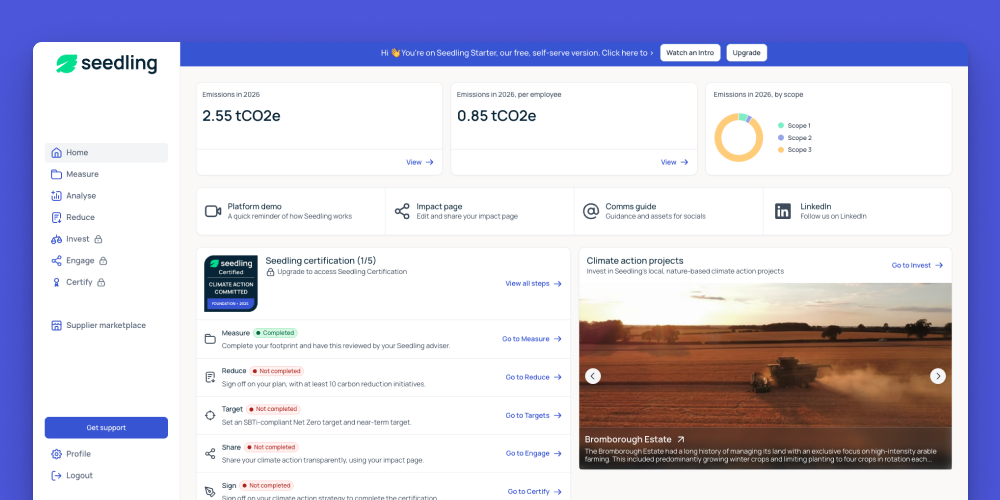
Best for: Companies of up to 2,000 employees where carbon sits alongside a broader ops, finance, or HSE role. Particularly strong for lean sustainability teams who want serious outputs without enterprise-level complexity.
Key features:
- Full Scope 1, 2, and 3 measurement aligned with the GHG Protocol
- Accounting integrations (Xero, Sage, QuickBooks) and built-in employee and supplier surveys
- AI-assisted spend-to-emissions category matching
- Bespoke, quantified decarbonisation plan built by your dedicated account manager
- SBTi-aligned target-setting and data-backed reduction modelling
- Compliance-ready outputs: GHG inventories, Net Zero Plans, PPN 006, B Corp, SECR, EcoVadis, ISO
- Timeline to finish: 2-4 weeks, under one day of your time overall
- Subscription pricing with no day-rate scope creep
Pricing: Transparent subscription pricing. See Seedling's pricing page.
Not sure where you stand? Try the free business carbon calculator to get a sense of your footprint before committing to a platform.
2. Watershed: Best Enterprise Platform for Action-Oriented Decarbonisation
Why we picked it: Watershed is an enterprise carbon management platform for companies serious about their climate commitments, excelling at measuring Scope 1, 2, and the notoriously difficult Scope 3 emissions with precision.
Crucially, it goes well beyond measurement. Watershed is built to drive progress against targets, not just report on them, with tools to set targets, spot decarbonisation levers, drive supplier performance, and invest in clean power and carbon removal assets. The platform is designed around action, not just reporting.

Best for: Large global enterprises with dedicated ESG teams. Clients include Airbnb, Stripe, FedEx, BlackRock, and Walmart.
Key features:
- Over 60 pre-built integrations with common enterprise systems including ERPs, cloud providers, and travel management tools.
- Built-in toolsets for preparing disclosures aligned with CSRD, SEC climate rules, CDP, and ISSB, with a clear, traceable audit trail for every calculation.
- Named a leader in the 2026 Green Quadrant for Enterprise Carbon Management Software by Verdantix, with market-leading scores across data acquisition, carbon calculation methodologies, and net-zero strategy support.
Watch out for: Packages start at approximately US$50,000 a year. Integrating Watershed into existing business processes may require significant effort, particularly for companies without established sustainability programmes.
3. Persefoni: Best for Financial Institutions and Investor-Grade Disclosure
Why we picked it: Persefoni is an enterprise-grade carbon accounting and climate disclosure platform built for companies that need investor-grade accuracy. Its audit-ready carbon ledger and alignment with frameworks including SEC, TCFD, and IFRS make it a top choice for financial institutions and global corporations.

Best for: Financial giants looking to quantify both operational and financed emissions with confidence. Also well-suited to large enterprises facing mandatory climate disclosure.
Key features:
- The Footprint Ledger manages emissions data with the same accuracy, granularity, and control as financial data.
- Net-zero target setting, reduction modelling, and supplier engagement for advanced decarbonisation.
- Embedded AI assists with anomaly detection, emissions-factor mapping, and intelligent insights via a GPT-style Copilot.
- Deep alignment with disclosure frameworks and tools to help companies achieve decarbonisation.
Watch out for: Setup can be time-intensive and may require dedicated technical and compliance resources, especially for smaller companies without in-house ESG expertise.
4. Sweep: Best for Distributed Organisations That Want Company-Wide Emissions Ownership
Why we picked it: Sweep is designed to turn carbon management into a team effort. With tools that assign ownership and track progress across departments, it is ideal for companies that want to embed emissions strategy into everyday decision-making.
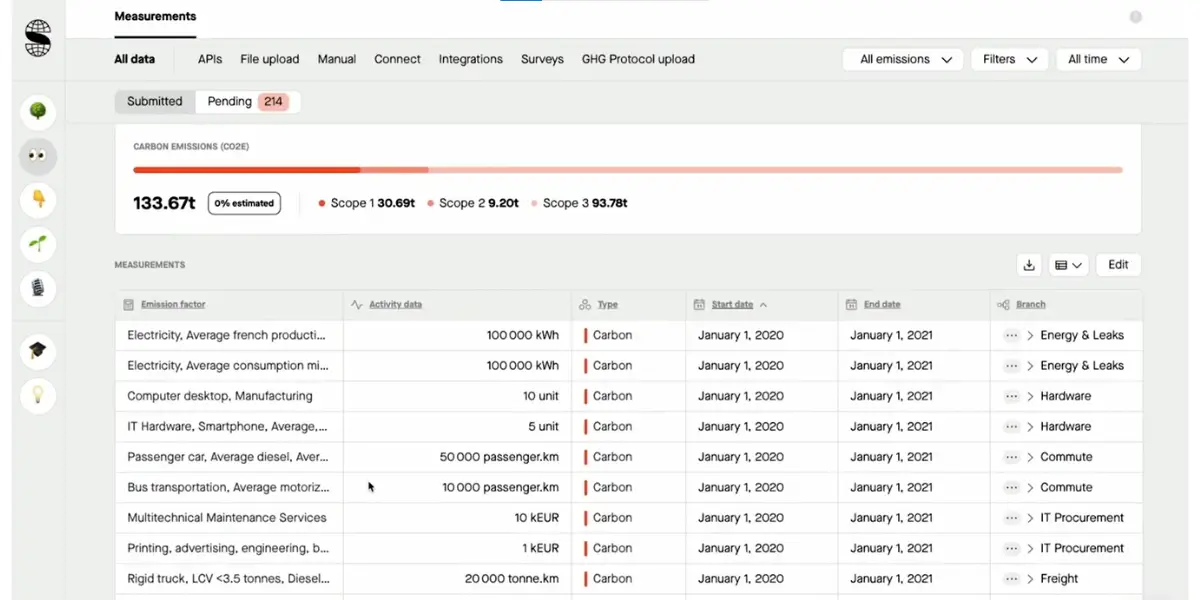
Best for: Organisations of all sizes with a graduated model to suit varying company sizes and different levels of data maturity and complexity. Particularly strong for enterprises with complex, distributed operations. Clients include L'Oréal, HP, EDF, and Burberry.
Key features:
- Write carbon data once and use it to report in line with all key sustainability frameworks: CSRD, GRI, ISSB, TCFD, CDP, and others.
- A task delegation system assigns specific carbon reduction responsibilities across the organisation and external partners, creating accountability at all levels.
- Strong solutions for tracking Scope 3 emissions across the entire value chain, and tools for financial organisations to track and manage the carbon footprint generated by their portfolios.
- Ranked as a leader among carbon accounting software in the latest IDC Vendor Marketscape Report.
Watch out for: The platform is less focused on reporting than others, and more on enabling internal ownership and change. It may not suit teams primarily looking for compliance-ready outputs.
5. Salesforce Net Zero Cloud: Best for Existing Salesforce Customers
Why we picked it: Salesforce Net Zero Cloud is a carbon accounting and sustainability management platform designed to help enterprises track and reduce their carbon emissions. It uses Salesforce's cloud-based infrastructure to provide data analytics and reporting capabilities, allowing companies to measure their carbon footprint across Scope 1, 2, and 3, set science-based targets, and monitor progress towards sustainability goals.
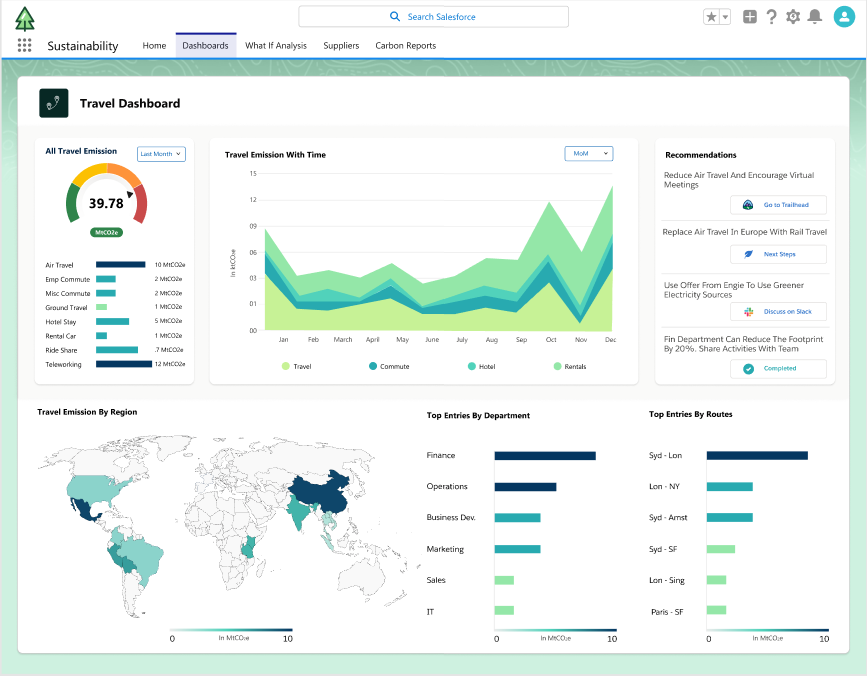
Best for: Existing Salesforce customers, for whom it offers the advantage of integration into daily operations, allowing carbon data to flow alongside all other ongoing work.
Key features:
- Scenario planning and forecasting tools, enabling organisations to model different approaches to emissions reduction.
- Scenario planning tools that allow companies to model different decarbonisation pathways and understand their financial implications, supporting investment decisions that balance climate ambition with business constraints.
- Native integration across the Salesforce CRM and ERP ecosystem.
Watch out for: Because Net Zero Cloud is built on Salesforce's existing data model, which was not originally designed for accounting, organisations often encounter limitations with complex emissions calculations, methodological transparency, and audit-ready workflows. Scalability and effectiveness can vary depending on the degree of customisation required.
6. IBM Environmental Intelligence Suite: Best for Climate Risk Analytics in Large Enterprises
Why we picked it: IBM Environmental Intelligence Suite is a carbon accounting software solution best designed for large companies, especially those focused on mitigating future carbon emissions. Its differentiation lies in risk, not just reporting.
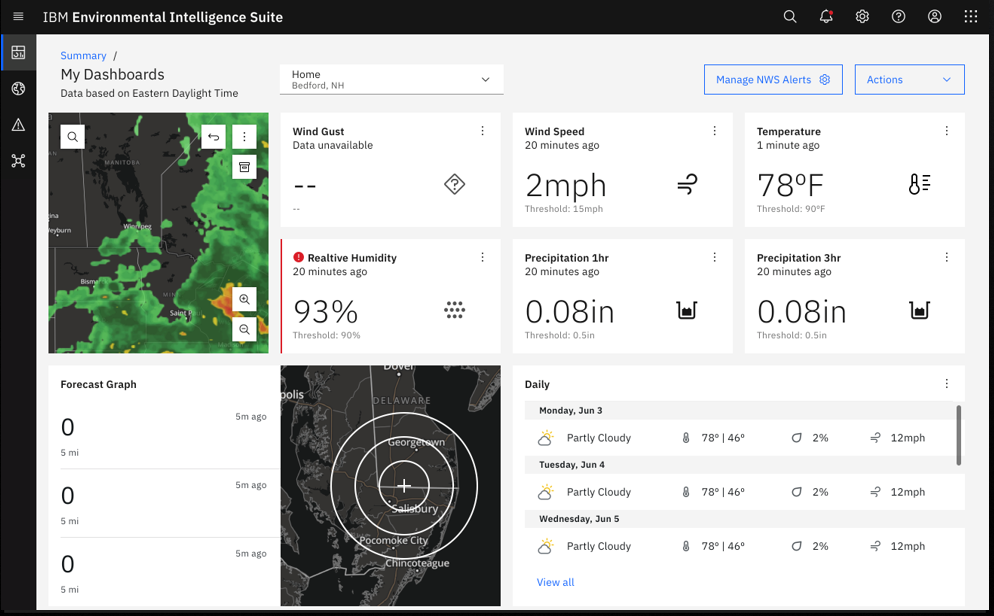
Best for: Enterprises with complex emissions profiles seeking emission reduction opportunities, as IBM's platform is best equipped to handle large datasets and provide predictive insights.
Key features:
- Uses AI to deliver climate change risk insights, helping large enterprises anticipate their energy consumption and future carbon emissions.
- Carbon management is enhanced by AI and predictive analytics, integrating carbon data with enterprise resource planning to improve auditability and sustainability workflows.
- A large part of IBM's offering focuses on risk analysis and response efforts.
Watch out for: IBM's acquisition of Envizi forms a platform that is largely legacy software aimed at managing large volumes of data, with basic climate risk analytics supported by IBM AI capabilities. Teams looking for a dedicated, modern carbon management workflow may find it less intuitive than purpose-built platforms.
What Is Carbon Management Software?
Carbon management software is a platform that helps organisations measure, track, and reduce their greenhouse gas emissions.
The best tools go well beyond a one-time footprint calculation. Carbon accounting software is a specialised platform that helps businesses track, calculate, and manage their greenhouse gas emissions and carbon footprint, supporting environmental reporting, sustainability goals, and compliance with emissions regulations. It simplifies data collection, analysis, and reporting to promote transparency and enhance investor confidence.
The distinction between carbon accounting software and carbon management software matters. Accounting gives you a number. Management gives you a plan. The platforms in this guide all offer target-setting and reduction planning, not just a footprint output.
For a deeper look at how carbon footprint tracking works for businesses, including what to measure and how to structure your data, see Seedling's dedicated guide.
Why Does Carbon Management Software Matter for Your Business?
The case for investing in proper carbon management software has shifted from optional to operational. Organisations are turning to carbon accounting platforms for regulatory compliance, investor and ratings alignment using standards like ISSB, TCFD, and SBTi, and to meet sustainability expectations from buyers and supply chain partners.
Beyond compliance, the real value is strategic. The right platform helps you identify emissions hotspots, model reduction scenarios, and chart a path to net zero, while also uncovering inefficiencies and cost-saving opportunities tied to energy and resource use.
The most impactful companies are not just measuring emissions, they are managing them. Scope 3 software platforms in particular are evolving from reporting tools into strategy engines, helping sustainability teams move beyond compliance and into continuous improvement.
How We Chose These Platforms
Every platform in this list was evaluated against the following criteria:
- Goes beyond measurement. We only included platforms with genuine target-setting and reduction planning functionality, not just footprint calculators.
- Methodological credibility. All platforms must align with the GHG Protocol and support Scope 1, 2, and 3 measurement. We checked for transparent emissions factor sourcing and audit-ready outputs.
- Fit for purpose. We considered who each platform is actually built for. Enterprise tools designed for large sustainability teams with complex reporting structures are not the right fit for a company of 200 people, and vice versa.
- Compliance coverage. We looked at which regulatory and voluntary frameworks each platform supports, including CSRD, SBTi, CDP, SECR, B Corp, and ISO 14064.
- Support model. Software alone is not enough for most teams. We assessed whether each platform offers meaningful expert guidance alongside the technology.
Seedling is one of the only platforms in this list that includes a dedicated carbon expert as a standard part of the subscription, not an optional add-on.
What to Look for in Carbon Management Software
Choosing the right platform comes down to five practical questions:
- Does it cover all three scopes? Scope 3 emissions typically account for the majority of a company's footprint. Any platform that stops at Scope 1 and 2 is not giving you the full picture.
- Does it support target-setting and reduction planning? Measurement is the starting point. The platform should help you set SBTi-aligned targets and model specific reduction actions, not just report a baseline.
- Is the methodology transparent and credible? Look for GHG Protocol alignment, clear emissions factor sourcing, and outputs that can be independently assured. Opaque calculations create problems at audit.
- Does it produce compliance-ready outputs? Check which frameworks the platform supports. If you need CSRD, SECR, B Corp, CDP, or PPN 006 outputs, confirm these are built in before you commit.
- 5. What support is included? Software without guidance is a common point of failure. For teams without a dedicated sustainability background, the quality of expert support matters as much as the features.
Seedling's platform overview covers how each of these areas is handled in practice, from data capture through to certified outputs.
About Seedling
Seedling is carbon management software trusted by 500+ businesses. It combines an accurate, full-scope carbon footprint (Scope 1, 2, and 3, aligned with the GHG Protocol) with a dedicated carbon expert who guides you through the entire process. Setup typically takes 2-4 weeks and under one day of your time. Outputs are compliance-ready for GHG inventories, Net Zero Plans, PPN 006, B Corp, SECR, EcoVadis, and ISO. Seedling is built for companies of up to 2,000 employees who want serious carbon management without enterprise-level complexity or consultant day rates.
Book a demo or calculate your business carbon footprint to get started.
Start Managing
Your Carbon Footprint
Today
Benchmark your business’s climate action for free


Ready to get started?

Book a demo with one of our experts today, or get started right away for free.
.svg)