The best scope 3 software depends on your sector and team size. Seedling is the strongest option for SMEs and mid-market businesses that need full-scope coverage, built-in employee and supplier engagement tools, and expert support without enterprise-level complexity. Sector-specific alternatives include MyEmissions for food businesses and Carbonfact for fashion and apparel.
Scope 3 is the hardest part of carbon accounting to get right. McKinsey estimates that Scope 3 emissions typically represent around 90 percent of a company's total emissions, though the figure can vary by industry and company.
Yet most businesses still rely on spend-based estimates and incomplete supplier data to report them.
This guide compares the best scope 3 software available in 2026, covering what each tool does well, who it suits, and what to watch out for. Whether you are managing carbon as part of a broader ops or compliance role, or you are a lean sustainability team looking for something more capable than a spreadsheet, there is a tool here for you.
The 7 Best Scope 3 Emissions Software Tools
1. Seedling: Best for SMEs and Mid-Market Businesses Needing Full-Scope Coverage with Expert Support
Why we picked it: Seedling is built for businesses of up to 2,000 employees that need accurate, GHG Protocol-aligned Scope 3 reporting without the complexity or cost of enterprise software. It combines intuitive carbon management software with a dedicated carbon expert, so you are not working out methodology on your own.
Best for: Ops leads, HSE managers, compliance managers, and lean sustainability teams managing carbon alongside other responsibilities.
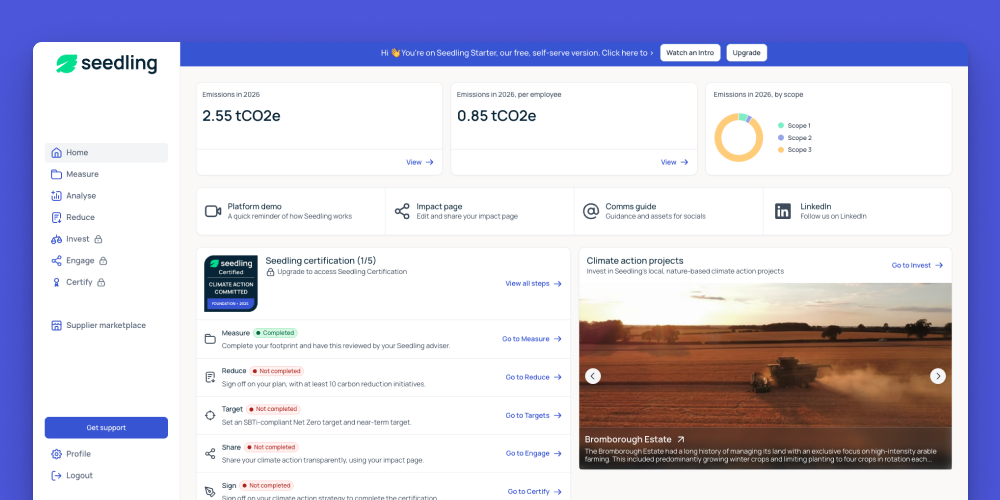
Scope 3 specific features:
- Activity data upload across multiple categories. Rather than relying purely on spend-based estimates, Seedling supports activity data upload across multiple Scope 3 sections, giving you more accurate, defensible figures where it matters most.
- Employee engagement survey. Seedling includes a built-in commuting and homeworking survey to capture employee commute emissions and work-from-home energy use. These are among the most commonly undercounted Scope 3 categories for office-based businesses.
- Supplier engagement tools. Seedling's supplier survey lets you capture emissions data directly from your suppliers and integrate their figures back into your overall footprint, moving you from estimated averages toward primary data over time.
- AI-assisted spend categorisation. An AI tool helps match your spend data to emissions categories, reducing the manual mapping work that makes Scope 3 so time-consuming.
- Accounting integrations. Xero, Sage, and QuickBooks integrations pull financial data directly into the platform, saving significant data preparation time.
Key outputs: GHG Protocol-aligned inventory, decarbonisation plan, SBTi-aligned targets, and compliance-ready reports for PPN 006, B Corp, SECR, EcoVadis, and ISO.
Time to Output: Typically 2-4 weeks end-to-end, with less than one day of your time overall.
Pricing: Subscription-based with transparent pricing. No day-rate scope creep.
Seedling is a strong fit if you want carbon footprint tracking for your business that covers all three scopes accurately, with a clear path to reduction. Book a demo to see the platform in action.
2. MyEmissions: Best for Food and Drink Businesses
Why we picked it: MyEmissions is a carbon reporting platform built for food and drink, designed to calculate product emissions and generate annual Scope 1, 2, and 3 reports. Food businesses find that Scope 3 is almost entirely dominated by purchased goods, and generic platforms rarely have the ingredient-level data needed to calculate it accurately. MyEmissions solves this.
Best for: Food producers, hospitality groups, caterers, and food retailers.

Key feature: MyEmissions has developed a data-driven life cycle assessment approach to instantly calculate the carbon emissions of a food product or meal, with a food emissions database covering all emissions from farm to store, including packaging and transport.
MyEmissions offers fully automated Scope 3 reporting, based on your purchased food and drink data. The platform also supports carbon labelling, allowing food businesses to display A-E ratings on menus and products.
Watch out for: MyEmissions is purpose-built for food. If your business spans multiple sectors, you will need a more generalist platform alongside it.
3. Carbonfact: Best for Fashion, Apparel, and Footwear Brands
Why we picked it: Focused exclusively on apparel and footwear, Carbonfact's granular supply chain knowledge enables it to deliver highly accurate results. For fashion brands, purchased goods (Scope 3.1) account for 80% of a fashion brand's emissions, making generic spend-based tools inadequate.
Best for: Fashion, textile, and footwear brands that need product-level LCAs and Scope 3.1 accuracy.

Key feature: Carbonfact's corporate emissions platform allows full calculation of Scopes 1, 2, and 3. Rather than relying on spend-based information, Carbonfact uses a product-centric approach when calculating emissions, making results more accurate and future-proof with upcoming regulations.
Watch out for: Carbonfact is built for fashion and footwear. Businesses outside these sectors will not benefit from its sector-specific emission factors and LCA methodology.
4. Watershed: Best for Large Enterprises with Complex Global Supply Chains
Why we picked it: Watershed offers a platform for measuring, reporting, and reducing Scope 1, 2, and 3 emissions at scale, best suited to large enterprises looking for an all-in-one solution to manage carbon data across global operations and supply chains.
Best for: Large, multi-entity businesses with complex supply chains and in-house sustainability teams.
Key feature: Strong supplier data collection workflows and scenario modelling for enterprise-scale decarbonisation programmes.
Watch out for: Watershed is built for organisations with sustainability teams and significant internal resources. It is not designed for lean teams managing carbon alongside other responsibilities.
5. Plan A: Best for Mid-to-Large Companies Focused on Compliance Reporting
Why we picked it: Plan A offers a platform for carbon accounting, target-setting, and compliance-aligned reporting, best suited to midsize to large companies seeking a science-led, compliance-focused platform with strong reduction planning tools.
Best for: Companies with dedicated sustainability resource that need to align reporting with multiple frameworks (CSRD, CDP, SBTi).
Key feature: Built-in compliance templates across a wide range of reporting frameworks, with supplier engagement functionality for supply chain data collection.
Watch out for: Plan A's breadth of features comes with a corresponding setup and management workload. It is less suited to businesses without in-house sustainability expertise. If you are comparing options, Seedling's Plan A alternatives page covers the differences in detail.
6. Normative: Best for Enterprises with Complex Supply Chain Networks
Why we picked it: Normative's Carbon Accounting and Carbon Network software offer a unified SaaS solution for capturing, modelling, and reporting carbon data. The software provides enhanced visibility into notoriously difficult-to-track Scope 3 emissions for more precise environmental impact management.
Best for: Large enterprises with distributed supplier networks that need collaborative tools across the value chain.
Key feature: Normative provides a free carbon calculator for smaller suppliers, aiding in emissions reduction planning and progress tracking. This helps larger organisations bring their supply chain along without requiring every supplier to invest in their own software.
Watch out for: Normative's platform is best suited for large enterprises with complex supply chains. It is not designed for SMEs.
7. Sweep: Best for Procurement Teams Automating Scope 3 Tracking
Why we picked it: Sweep suits procurement or sustainability teams looking to automate Scope 3 tracking and engage suppliers with compliance-ready tools.
Best for: Organisations where procurement and sustainability functions work closely together on supply chain decarbonisation.
Key feature: Sweep enables sustainability and procurement teams to work together to build climate programmes that clearly track progress towards reduction goals. Supplier engagement is central to the platform's design.
Watch out for: Sweep is best suited to organisations with existing data maturity and dedicated sustainability resources. It is not a starting-point tool for businesses new to carbon accounting.
How We Chose These Tools
Every tool on this list was evaluated against the following criteria:
- Scope 3 category coverage: Does the platform cover the categories relevant to most businesses, including purchased goods, employee commuting, homeworking, business travel, and supply chain emissions?
- Data quality: Does the platform support activity data and primary supplier data, or does it rely entirely on spend-based estimates?
- Supplier engagement: Are there built-in tools to collect emissions data from suppliers and integrate it into the footprint?
- Fit for team size: Is the platform designed for the team size and resource level it claims to serve?
- Expert support: Is there genuine human expertise available, or is it self-serve only?
- Output quality: Are the outputs usable for real-world compliance requirements (GHG Protocol, SBTi, B Corp, PPN 006, SECR, etc.)?
What Should You Look for in Scope 3 Software?
Scope 3 software refers to platforms built specifically to calculate, track, and manage value chain emissions: the indirect greenhouse gas emissions not owned or controlled by the reporting company, from upstream suppliers to downstream logistics and product use.
The right platform depends heavily on your situation. Here are the features that matter most:
- Activity data support. Spend-based estimates are a starting point, not a destination. The best tools let you upload activity data across multiple Scope 3 categories to improve accuracy over time.
- Employee surveys. Commuting and homeworking are consistently undercounted. Look for platforms with built-in survey tools that capture this data directly from employees.
- Supplier engagement. Getting suppliers to engage in carbon emissions tracking is a significant challenge. Many suppliers, especially smaller ones, may not have the tools, processes, or awareness to track and report their emissions, which can create significant gaps in data. Software with a supplier portal or survey function addresses this directly.
- GHG Protocol alignment. Any output you use for stakeholder reporting, compliance, or SBTi target-setting needs to be aligned with the GHG Protocol. Verify this before committing.
- Expert support. Access to expert support for implementing and maintaining the software helps organisations manage carbon accounting, reporting, and decarbonisation processes. Self-serve tools are fine for simple footprints. For Scope 3, most businesses benefit from guidance.
Is Scope 3 Reporting Mandatory?
Regulations like the EU's Corporate Sustainability Reporting Directive (CSRD) now require Scope 3 emission disclosures for companies in scope. In the UK, Scope 3 is increasingly expected by procurement bodies, investors, and frameworks including B Corp and SBTi.
Even where it is not yet mandatory, only 37% of Scope 3 emissions from EU businesses are currently being addressed with decarbonisation measures, and companies are turning to Scope 3 reporting software to improve the accuracy of their emissions tracking so they are in a better position to reduce them.
For UK businesses supplying public sector contracts, a Carbon Reduction Plan is already required under PPN 06/21, and Scope 3 coverage is part of what makes that plan credible.
About Seedling
Seedling is carbon management software trusted by 500+ businesses. The platform covers Scopes 1, 2, and 3 in full, aligned with the GHG Protocol, and pairs powerful software with a dedicated carbon expert who guides you through measurement, reduction planning, and reporting.
Seedling is built for businesses of 20-2,000 employees that want accurate carbon accounting without it becoming a full-time job. Outputs are compliance-ready for PPN 006, B Corp, SECR, EcoVadis, ISO 14064, and SBTi.
Start Managing
Your Carbon Footprint
Today
Benchmark your business’s climate action for free


Ready to get started?

Book a demo with one of our experts today, or get started right away for free.
.svg)