.png)
Overview
The Science Based Targets initiative (SBTi) is the global body that validates corporate emissions reduction targets, confirming whether a company's Net Zero commitment is genuinely aligned with the science needed to limit warming to 1.5°C. For most companies, the core calculation method for setting near-term targets is the Absolute Contraction Approach (ACA), which determines the annual rate at which a business must reduce its absolute emissions.
In April 2026, the SBTi updated how the ACA works. Under the previous approach, a company had to cut a fixed amount equivalent to 4.2% of its base-year emissions each year, with a 42% total reduction by 2030 required regardless of when targets were set. A business with a 2025 base year faced the same total cut as one that started in 2020, but with only half the time to achieve it -- a gap that had made the method increasingly difficult to apply in practice.
The revised method adjusts annual reduction rates based on how much time a company has remaining before its net-zero deadline, with companies that acted earlier having their prior progress fully recognised. Although described by the SBTi as a "non-substantive update", the revised calculation can materially lower the minimum annual reductions required for companies with recent base years. The update also brings the method into alignment with the forthcoming Corporate Net-Zero Standard V2.0, and targets previously validated under the earlier version remain valid.
Background: Near-Term Targets and the Absolute Contraction Approach
When a company commits to a Science Based Target, it sets two types of reduction target: a near-term target covering the next five to ten years, and a long-term target aligned with net zero by 2050 at the latest. The near-term target is the more immediate commitment, and the one most directly tied to a business's current decarbonisation plans.
For most companies, near-term scope 1 and 2 targets are calculated using the Absolute Contraction Approach (ACA). The ACA sets a required annual reduction rate and applies it linearly from the company's base year to its target year.
The principle is straightforward: the emissions pathway must be consistent with limiting global heating to 1.5°C, which means reducing combined scope 1 and 2 emissions at a pace that, if sustained, gets the business to net zero by 2050.
What Changed in v1.3.1
The problem with v1.3
The previous version of the ACA included an adjustment for companies with base years after 2020. The idea was sound: if a company only began measuring its emissions in, say, 2023, its recorded baseline would not reflect the actual emissions it had produced in the years since 2020. The adjustment was intended to account for that gap, ensuring those companies were held to an appropriately ambitious reduction pathway rather than benefiting from an artificially low starting point. In principle, requiring steeper reductions from companies that started later was a fair way to maintain overall ambition. In practice, however, the further past 2020 a company's base year fell, the higher the required annual reduction rate became -- and by the time companies were setting targets in 2025 or 2026, the figures had reached a point where they were simply not achievable within the near-term window.
The knock-on effect was real: businesses completing their first emissions measurement and looking to set an SBTi target were confronted with near-term reduction requirements that were either impossible to justify to their boards or unlikely to survive SBTi’s own validation process.
The fix: a dynamic rate adjustment
Version 1.3.1, published in April 2026, replaces the post-2020 penalty with a dynamic rate adjustment. Rather than adding a fixed correction based on how many years have passed since 2020, the new method calculates the required annual rate directly from the time remaining between the company’s base year and the relevant net-zero year.
The logic is clean: if you have 26 years to reduce scope 1 emissions by 90%, you need to reduce by roughly 3.46% per year. If you have 25 years, the rate rises slightly to 3.60%. The rate adjusts dynamically as the runway shortens, but it scales proportionally rather than jumping sharply as the old adjustment did.
To prevent the gentler near-term slope from increasing total cumulative emissions over the full pathway, the method builds in an assumption that scope 2 emissions reach zero by 2040. This tightens the long-term trajectory in line with expected grid decarbonisation, rather than front-loading reductions into years where the technology and infrastructure may not yet be in place.
Minimum ambition floors
The dynamic rate does not mean any reduction rate is acceptable. Minimum annual reduction floors remain in place for each target type, acting as a backstop to ensure no validated target falls below a meaningful level of ambition.
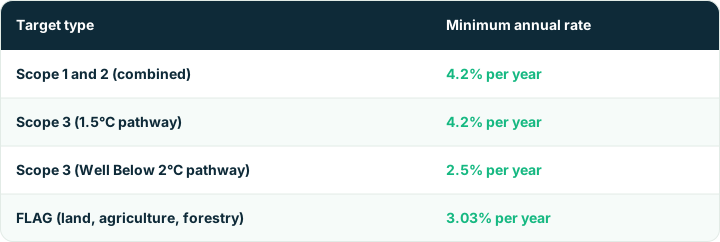
The dynamic rate does not mean any reduction rate is acceptable. Minimum annual reduction floors remain in place for each target type, acting as a backstop to ensure no validated target falls below a meaningful level of ambition.
In practice the floor is most relevant for heavily scope 1-weighted businesses, where the dynamic rate can calculate below 4.2%. For any business with meaningful electricity consumption, the dynamic rate will typically sit above the floor.
When did this come into effect?
The v1.3.1 method appendix was published and came into effect on 14 April 2026. Companies submitting new targets from that date are assessed under the updated methodology. Businesses with targets already validated under v1.3 are not automatically required to revise them, though the new method would in most cases produce a less onerous near-term requirement.
Worked Example: A Professional Services Business
Consider Meridian Advisory, a 300-person professional services firm with offices in London and Bristol. The business has completed its first full GHG inventory and is ready to set its SBTi near-term target.
Its scope 1 and 2 emissions for the 2025 base year break down as follows, with an even split between the two scopes:
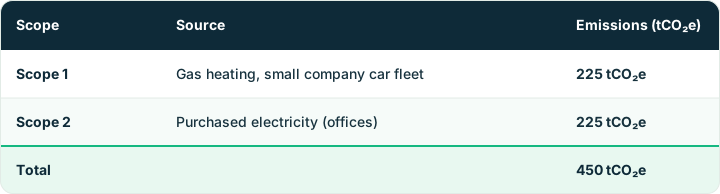
Meridian wants to set a near-term target with a 2025 base year and a 2030 target year, covering five years of reduction.
Step 1: Establish the emissions split
The ACA does not treat scope 1 and scope 2 as interchangeable. Each scope has a different net-zero year and a different required ambition level, reflecting the distinct pathways for direct combustion versus purchased electricity. The method therefore calculates a separate annual reduction rate for each scope and then blends them in proportion to the company’s actual emissions.
Meridian’s emissions split:
- Scope 1 share: 225 ÷ 450 = 50.0%
- Scope 2 share: 225 ÷ 450 = 50.0%
This even 50/50 split is illustrative of a business with both significant office electricity use and meaningful direct emissions from heating and fleet. It sits neatly between the two scope-specific rates and makes the blending calculation straightforward to follow.
Step 2: Calculate the dynamic rate for each scope
The dynamic rate for each scope is calculated by dividing the required ambition by the years remaining to the net-zero year, measured from the most recent year (2025 in this case).
Scope 1
Net-zero ambition: 90% | Net-zero year: 2050 | Years remaining: 2050 − 2025 = 25
- Scope 1 rate: 90% ÷ 25 = 3.60% per year
Scope 2
Net-zero ambition: 100% | Net-zero year: 2040 | Years remaining: 2040 − 2025 = 15
- Scope 2 rate: 100% ÷ 15 = 6.67% per year
Scope 2 requires a steeper annual rate because the runway is shorter: 15 years to reach 100% versus 25 years to reach 90%. The method treats the electricity grid as decarbonising by 2040 and sets the required pace accordingly.
Step 3: Blend the rates by emissions split
The two scope-specific rates are weighted by each scope’s share of total emissions:
- Scope 1 contribution: 3.60% × 0.50 = 1.80%
- Scope 2 contribution: 6.67% × 0.50 = 3.335%
- Blended rate: 1.80% + 3.335% = 5.135% per year
Floor check: 5.135% is above the 4.2% minimum floor, so the floor does not apply. The required rate of 5.135% per year stands.
Step 4: Apply to the target window
The target runs from 2025 to 2030, a five-year window:
- Required reduction: 5.135% × 5 = 25.7%
- Target emissions: 450 × (1 − 0.257) = 334.4 tCO₂e by 2030
The SBTi-aligned near-term target under v1.3.1 is therefore a 25.7% reduction in combined scope 1 and 2 emissions by 2030 from a 2025 base year, reaching approximately 334 tCO2e.
Before vs After: How the Target Changes
Under the old v1.3 methodology, Meridian’s 2025 base year triggered the post-2020 adjustment. The documented adjusted rate for a 2025 base year was 8.4% per year, applied to the combined scope 1+2 total regardless of the scope split.
- v1.3 required reduction: 8.4% × 5 = 42.0% by 2030
- v1.3 target emissions: 450 × (1 − 0.420) = 261.0 tCO₂e
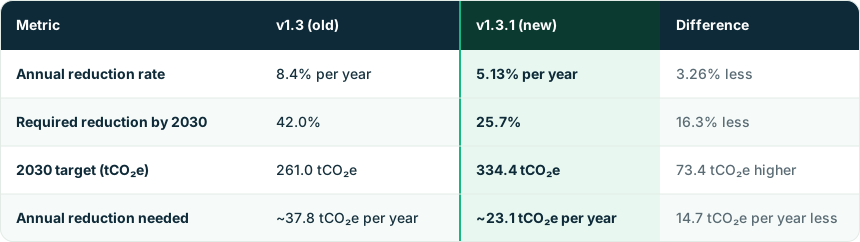
The difference is material. Under v1.3, Meridian would have needed to cut almost 38 tonnes every year for five years, a reduction of nearly half its entire emissions base. Under v1.3.1, the same business needs to cut roughly 23 tonnes per year, which maps onto real and achievable interventions: switching to a renewable electricity tariff, upgrading office heating controls, and accelerating EV transition for the company fleet.
The science behind the pathway has not changed. The ambition has not been softened. What has changed is that the calculation now reflects what the business actually needs to do from its starting point in 2025, rather than applying a penalty for the years before it began measuring.
What This Means in Practice
For businesses working through their first SBTi submission, v1.3.1 removes an increasing barrier. Companies with base years from 2024 onwards will now face near-term targets built around what their operations can more realistically deliver, rather than a rate inflated by a methodological quirk.
For those yet to submit a target, the updated method is the one that applies. And for those previously put off by the rates v1.3 was producing, the main technical objection is now gone.
Start Managing
Your Carbon Footprint
Today
Benchmark your business’s climate action for free


Ready to get started?

Book a demo with one of our experts today, or get started right away for free.
.svg)